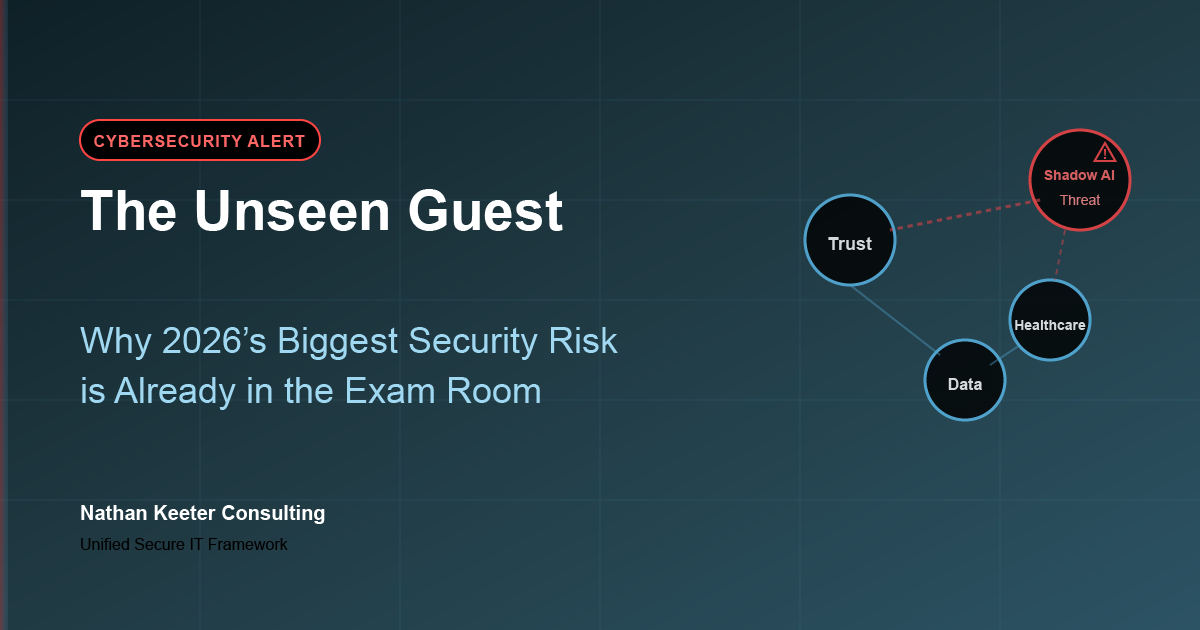
The Unseen Guest: Why 2026’s Biggest Security Risk is Already in the Exam Room
If you walked into a boardroom in 2024 and asked for a budget to put a recording device in every patient exam room that transmitted data to an unvetted third-party cloud, you would have been fired.
In 2026, we’re doing it voluntarily.
While cybersecurity leadership has been laser-focused on hardening the perimeter against ransomware and preparing for increasingly aggressive OCR enforcement and state privacy regulations, a silent shift has occurred inside the clinical workflow: the rise of “Shadow AI”—specifically, ambient listening and AI scribe technology.
Recent industry reports from late 2025 indicate that nearly 30% of physician practices have adopted some form of AI documentation tool. The driver is understandable: these tools promise to address the epidemic of clinician burnout by automating the drudgery of EHR data entry.
But for healthcare executives and CISOs, this represents a critical new attack vector that isn’t hitting the firewall—it’s bypassing it entirely via the physician’s personal smartphone.
The “App Store” Vulnerability
The core problem isn’t the technology itself. Enterprise-grade, BAA-covered AI tools represent legitimate innovation. The problem is the delivery method.
Frustrated by administrative burdens and glacial IT procurement cycles, clinicians are increasingly downloading “freemium” or consumer-grade AI scribe apps on their personal devices. They bring these phones into the exam room, record sensitive patient consultations, and let generic Large Language Models process the data in unknown clouds.
This creates three critical liabilities:
1. The Data Leakage Nightmare
When a physician uses an unvetted app, where does that voice data go? Is it used to train the vendor’s public model? Is it stored in a HIPAA-compliant jurisdiction? If that startup pivots or gets acquired, who owns the patient voice prints?
We’re witnessing a massive, decentralized exfiltration of PHI occurring under the guise of productivity.
2. The Integrity Gap
Security isn’t just about confidentiality—it’s about integrity. Early studies from late 2025 warn that even high-performing medical LLMs can have hallucination rates between 1-3%. In creative writing, a 1% error rate is quirky. In clinical documentation—dosages, allergies, diagnoses—it’s a patient safety event.
If an AI “hallucinates” a penicillin allergy that doesn’t exist, or misses one that does, and that fabricated data is pasted into the EHR, the medical record itself becomes corrupted. The integrity of patient care is compromised at the source.
3. The HIPAA “Gray Zone”
If a doctor uses a personal app to record a patient without a Business Associate Agreement in place, the organization is in violation of HIPAA the moment the “record” button is pressed. Yet because this is happening on personal devices inside closed exam rooms, IT security has zero visibility until a breach occurs—or worse, until a patient safety incident forces an investigation.
The Executive Pivot: Governance Over Prohibition
The knee-jerk security response is to ban these tools outright. This is a strategic mistake.
You cannot ban a cure for burnout. If you block the “Shadow Scribes,” you’re effectively telling clinical staff that you value compliance theater over their mental health and productivity. They’ll simply find better ways to hide the apps—and your visibility drops to zero.
Instead, 2026 must be the year of aggressive adoption with rigorous governance.
Sanction the Solution: Rapidly procure and deploy an enterprise-grade, secure AI scribe solution. Give your clinicians a safe, approved alternative that works better than the consumer apps they’re downloading. Make it easier to do the right thing than the risky thing.
Update Your BYOD Policy: Explicitly address “ambient listening” and “generative AI” in your Acceptable Use Policies. Make it clear that recording patient audio on unapproved apps is a termination-level offense, not just a policy violation. This isn’t IT being difficult—this is patient safety and regulatory survival.
Verify the Vendor: Demand transparency on the complete data lifecycle. Does the audio persist after transcription? Is the data used for model training? Where are the servers located? If the vendor’s answers are vague or evasive, the contract is a non-starter. Your BAA must be airtight, and you need audit rights.
Monitor and Educate: Deploy network monitoring to detect unauthorized cloud uploads from clinical areas. Conduct regular training that explains why these tools are dangerous, not just that they’re forbidden. Clinical staff need to understand they’re not just protecting the organization—they’re protecting their patients and their licenses.
The Bottom Line
The “Unseen Guest” is already in the exam room. Our job as security leaders is no longer to lock the door after the horse has bolted—it’s to ensure that every guest has been properly vetted, credentialed, and is working for us, not against us.
The era of Shadow AI in healthcare is here. The question isn’t whether we’ll adopt these tools, but whether we’ll control them before they control our risk profile.
Update Your BYOD Policy: Explicitly address “ambient listening” and “generative AI” in your Acceptable Use Policies. Make it clear that recording patient audio on unapproved apps is a termination-level offense, not just a policy violation. This isn’t IT being difficult—this is patient safety and regulatory survival.
Verify the Vendor: Demand transparency on the complete data lifecycle. Does the audio persist after transcription? Is the data used for model training? Where are the servers located? If the vendor’s answers are vague or evasive, the contract is a non-starter. Your BAA must be airtight, and you need audit rights.
Monitor and Educate: Deploy network monitoring to detect unauthorized cloud uploads from clinical areas. Conduct regular training that explains why these tools are dangerous, not just that they’re forbidden. Clinical staff need to understand they’re not just protecting the organization—they’re protecting their patients and their licenses.
The Bottom Line
The “Unseen Guest” is already in the exam room. Our job as security leaders is no longer to lock the door after the horse has bolted—it’s to ensure that every guest has been properly vetted, credentialed, and is working for us, not against us.
The era of Shadow AI in healthcare is here. The question isn’t whether we’ll adopt these tools, but whether we’ll control them before they control our risk profile.