The CSITO Role: Why Healthcare Needs a New Kind of IT Leader
Traditional CIOs manage technology. Chief Security Officers manage security. But in healthcare, where IT infrastructure directly impacts patient care and organizational survival, who manages the unified ecosystem that actually delivers both operational excellence and security resilience?
The answer is emerging: the Chief Secure Information Technology Officer (CSITO).
The Problem with Traditional IT Leadership
Healthcare organizations typically structure their technology functions around a familiar model: a CIO oversees IT infrastructure and operations, while a CSO or CISO manages cybersecurity as a separate domain. Clinical informatics often operates as yet another silo, focused on EHR optimization and clinical workflows.
This organizational separation made sense in an earlier era. IT was about keeping systems running. Security was about compliance checkboxes. Clinical systems were specialized tools that required dedicated expertise.
That era is over.
Today’s healthcare environment demands something different. When a ransomware attack shuts down your hospital, it’s not an “IT problem” or a “security problem”—it’s an organizational crisis that affects patient safety, revenue, reputation, and board liability simultaneously. When clinical staff work around security controls because they impede care delivery, you don’t have a “training problem”—you have a fundamental misalignment between how technology is designed and how care is actually delivered.
What Makes a CSITO Different
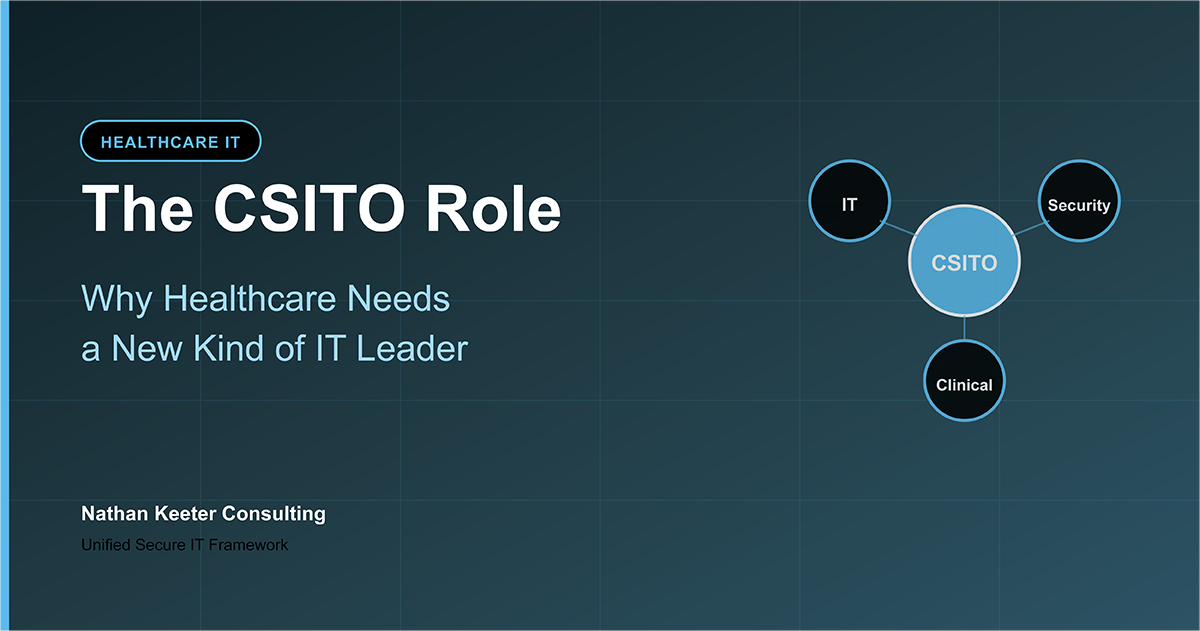
The Chief Secure IT Officer role represents a fundamental reconception of technology leadership. Rather than managing IT and security as parallel functions that occasionally coordinate, the CSITO leads a unified organization where security is embedded into every technology decision from inception.
The CSITO is not:
- A CIO who took a security course
- A CISO with expanded responsibilities
- A compromise between competing executives
The CSITO is:
- A strategic leader who understands that in healthcare, technology security and operational effectiveness are inseparable
- An executive who can speak credibly to both boards about risk governance and to clinicians about workflow optimization
- A unifier who eliminates the organizational silos that create security gaps and operational friction
The Structural Change
Under the CSITO model, security analysts don’t sit in a separate department that reviews IT projects at the end. They’re embedded within infrastructure teams, participating in architecture decisions from day one. Security engineering isn’t a compliance function—it’s core to how systems are designed, deployed, and maintained.
Clinical integration specialists don’t fight with IT over access controls. They collaborate on designs that serve clinical workflows while maintaining necessary security boundaries. Technology deployment considers patient care requirements and security imperatives as equally important constraints, not competing priorities.
This isn’t just reorganization. It’s a recognition that healthcare technology has become too critical, too complex, and too dangerous to manage through siloed departments that coordinate through meetings and tickets.
Why This Matters to Boards
Healthcare boards face unprecedented personal liability for cybersecurity failures. Recent legal and regulatory developments have made clear that “we had a CISO” is not adequate defense when breaches occur due to systemic organizational failures.
What boards need to demonstrate is not that they hired security professionals, but that they structured their organization to actually achieve security outcomes. The CSITO model provides that structural foundation.
When technology, security, and clinical operations are unified under strategic leadership with board-level accountability, several things happen:
Demonstrable governance: Clear lines of authority and accountability for technology risk
Reduced redundancy: Elimination of duplicate tools, conflicting policies, and wasted spending
Faster deployment: Projects move at the speed of integrated teams, not sequential handoffs
Better outcomes: Technology that serves clinical needs while maintaining security integrity
The Unified Secure IT Framework
At Nathan Keeter Consulting, we’ve formalized this approach into what we call the Unified Secure IT (USIT) Framework. USIT provides healthcare organizations with a methodology for restructuring technology leadership to achieve operational excellence and security resilience simultaneously.
The framework addresses three core domains:
Organizational Structure: How to unify previously siloed functions under strategic leadership
Process Integration: How to embed security into operations rather than bolting it on
Governance Framework: How to provide boards with visibility and accountability
Organizations implementing USIT don’t just get better security or more efficient IT. They get technology infrastructure that actually serves their healthcare mission—enabling clinicians, protecting patients, and shielding leadership from liability.
What This Means for Your Organization
If your organization still operates with separate CIO and CISO roles, you’re not necessarily doing it wrong. But ask yourself:
- When IT and security disagree, who decides?
- How many tools do you pay for twice because IT and security each bought their own?
- How often do security requirements slow down projects because they’re added at the end?
- Does your board understand who is actually accountable for technology risk?
If any of those questions reveal friction, gaps, or ambiguity, the CSITO model deserves serious consideration.
Healthcare is the most targeted industry for cyberattacks precisely because our organizational structures create exploitable gaps. Unifying technology leadership under a CSITO doesn’t just make theoretical sense—it closes the specific vulnerabilities that threat actors are actively exploiting.
The question isn’t whether healthcare needs better IT and better security. We all agree on that. The question is whether traditional organizational structures can deliver those outcomes, or whether we need a fundamental reconception of how technology leadership works in healthcare.
The evidence increasingly suggests that the era of the CSITO has arrived.
Nathan Keeter is founder of Nathan Keeter Consulting, which helps healthcare organizations implement the Unified Secure IT Framework. Contact us to discuss how the CSITO model could work for your organization.