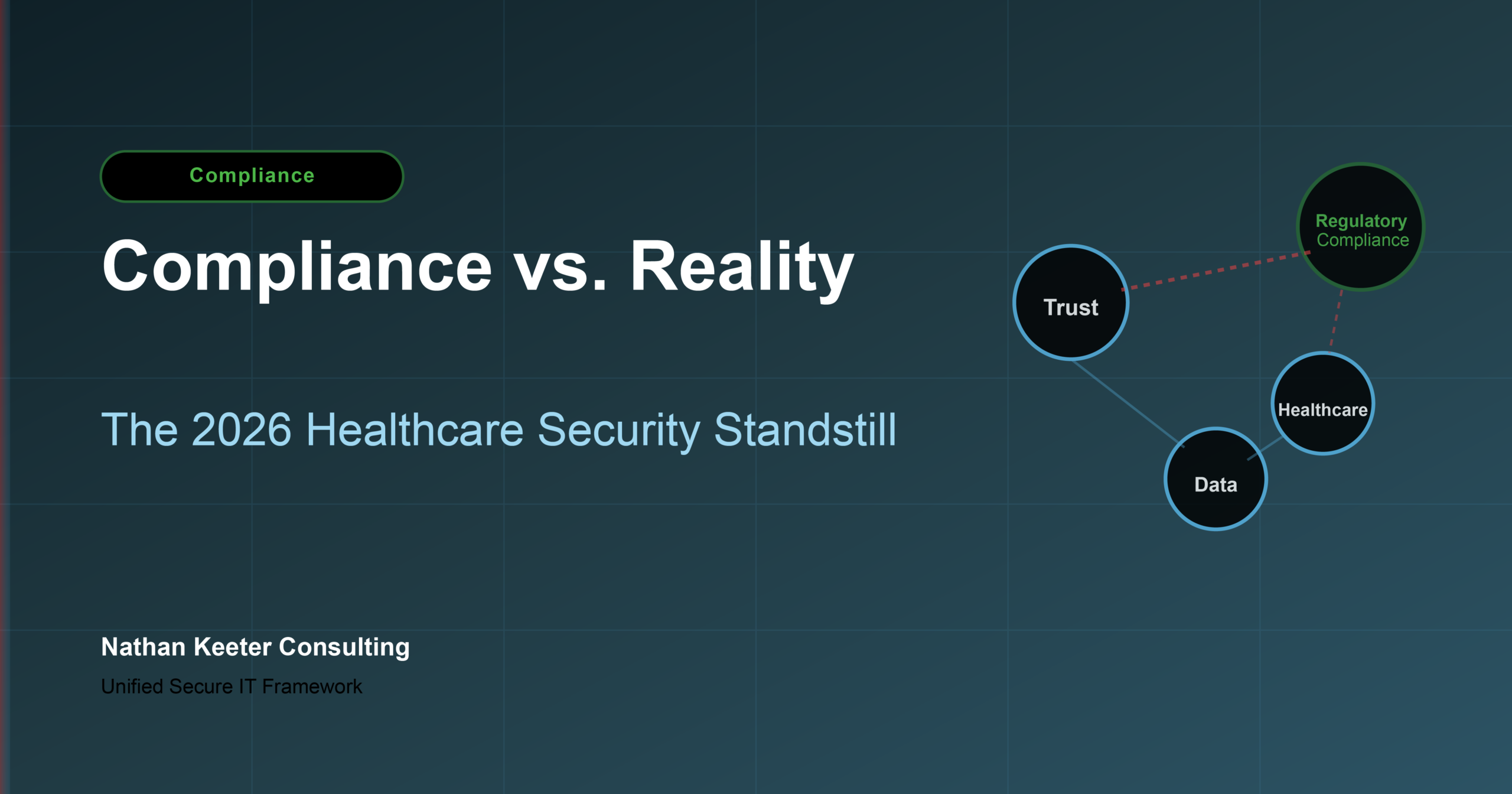
Compliance vs. Reality: The 2026 Healthcare Security Standstill
If the last few weeks have taught us anything, it’s that the “voluntary” era of healthcare cybersecurity is officially gasping its last breath—but the transition to a mandatory footing is going to be anything but smooth.
As we settle into 2026, the industry is currently locked in a tense stare-down. On one side, we have the Department of Health and Human Services (HHS) pushing for the first major update to the HIPAA Security Rule in over a decade. On the other, we have a coalition of over 100 provider organizations who, as of last month’s open letter, are urging the HHS to pump the brakes.
For security leaders, this regulatory deadlock creates a dangerous “wait and see” environment. Here is why you cannot afford to wait, and why the CMMC 2.0 rollout offers a better roadmap for what’s coming than the stalled HIPAA updates.
The “Too Much, Too Fast” Argument
The pushback from provider groups in December 2025 was predictable. They argue that the proposed mandates—strict multi-factor authentication (MFA) requirements, encryption standards, and aggressive 72-hour incident response windows—are financially unfeasible for smaller providers already operating on razor-thin margins.
They aren’t wrong about the cost. But they are wrong about the threat.
The ghost of the Change Healthcare attack (which we are still operationally recovering from nearly two years later) proved that the “weakest link” theory is no longer theoretical. Threat actors don’t care about your budget cycles. They care about your third-party connections.
The CMMC Parallels
While healthcare debates the new HIPAA rule, the Defense Industrial Base (DIB) has already lost the option to argue. As of November 2025, CMMC 2.0 is live in contracts.
Why does this matter to healthcare? Because the federal government is signaling its intent across all critical infrastructure sectors. The CMMC rollout demonstrates that the government is done accepting “self-attestation” without verification.
We are seeing a convergence of standards. The HHS Cybersecurity Performance Goals (CPGs)—which were voluntary last year—are essentially the blueprint for the mandated HIPAA updates. Whether the new rule passes in its current form or is watered down, the standard of care for negligence lawsuits has effectively shifted. If you aren’t meeting the “Essential” CPGs today, you are already negligent in the eyes of an auditor or a plaintiff’s attorney, regardless of what the final rule says.
The Real Battlefield: Third-Party Risk (TPRM)
The 2025 breach statistics painted a clear picture: catastrophic data loss is rarely happening because a hospital’s main firewall failed. It’s happening because a Business Associate (BA), a clearinghouse, or a seemingly benign SaaS vendor got hit.
In 2026, your internal security posture is only as strong as your vendor’s contract. The new battleground isn’t your SOC; it’s your procurement department.
Actionable Steps for Q1 2026
Stop waiting for the HHS to finalize the rule. The writing is on the wall. Here is where you should focus your energy this quarter:
- Audit Your “Flow-Down” Clauses: Take a page from the CMMC playbook. If you require MFA and encryption internally, you must contractually mandate it for any vendor touching your PHI. If they can’t prove they are doing it, they are a liability you can’t afford.
- Treat CPGs as Mandatory: Ignore the “voluntary” label on the HHS Cybersecurity Performance Goals. Gap-assess your organization against the “Essential” goals immediately. This is your new baseline for defensibility.
- Segregate Backup Environments: The rise of “double extortion” ransomware in late 2025 showed that backups are often the first target. Ensure your recovery environment is completely air-gapped or immutable.
The Bottom Line: Regulations will always lag behind the threat landscape. While the industry fights over the “letter” of the new HIPAA law, your job is to focus on the “spirit” of it: resilience. The cost of compliance is high, but as we’ve seen, the cost of a shutdown is existential.