Data Theft First, System Disruption Second: What the Inotiv Breach Reveals About Modern Ransomware
The rules of ransomware have changed, and many healthcare organizations are still defending against yesterday’s threats.
In early December 2025, pharmaceutical firm Inotiv disclosed a ransomware attack that followed a disturbing but increasingly common pattern: attackers stole 176 gigabytes of sensitive data—including personal, financial, and medical information belonging to employees, family members, and others—before systems were restored. The extortion group Qilin briefly listed the stolen data on a dark web site, making their intentions clear: the data itself was the weapon, not the encrypted systems.
This represents a fundamental shift in how ransomware attacks operate, and it exposes a critical vulnerability in how most healthcare organizations structure their security operations.
The Double-Extortion Model: Why Data Theft Came First
Traditional ransomware followed a simple playbook: lock the systems, demand payment for the decryption key. Organizations with solid backups could recover without paying. Attackers knew this, so they evolved.
The modern double-extortion model works differently:
Phase 1: Infiltrate and extract. Attackers spend days or weeks inside your network, identifying and exfiltrating your most sensitive data—patient records, employee information, financial data, trade secrets, research data.
Phase 2: Establish leverage. With data in hand, attackers now have multiple pressure points: regulatory penalties, reputation damage, legal liability, competitive exposure.
Phase 3: Deploy ransomware (optional). System encryption becomes secondary. Whether you can restore from backups is now irrelevant—the attackers already have what matters most.
In Inotiv’s case, 176 GB of personal, financial, and medical data was extracted. That’s not system logs or benign files. That’s real people’s sensitive information—employees who trusted their employer to protect their data, family members who never consented to having their information stored, individuals whose medical histories are now potentially available to criminals.
Why Siloed Structures Can’t Stop This
The Inotiv breach illustrates why traditional IT organizational structures are fundamentally inadequate against modern threats.
Consider the typical healthcare organization’s response timeline to a sophisticated attack:
Day 1-7: Attackers gain initial access, often through a compromised credential or unpatched vulnerability. The security team might see anomalous activity, but lacks context about normal operational patterns. The IT team knows the systems but isn’t monitoring for security events. Clinical technology operates independently and may not even be visible to either group.
Day 8-21: Attackers move laterally, mapping the network and identifying valuable data stores. Security tools generate alerts, but without unified visibility, the pattern isn’t recognized as a coordinated campaign. Different teams use different monitoring systems, creating blind spots at every boundary.
Day 22-30: Data exfiltration begins. 176 GB doesn’t leave your network instantly—it takes time and generates traffic. But if your security monitoring is separate from your network operations, and your data governance is owned by yet another team, who’s correlating the signals? Who has authority to act decisively?
Day 31: Ransomware deploys. By now, the real damage is done. The encryption is just the announcement.
This isn’t a technology failure. It’s a structural failure.
The Liability Question Your Board Should Be Asking
After Inotiv’s disclosure, affected individuals will receive notification letters. Some will face identity theft, financial fraud, or medical privacy violations. Legal claims will likely follow. Regulatory investigations will examine whether adequate safeguards were in place.
The board-level question isn’t “Did we have security tools?” It’s “Did we have organizational structures that could have prevented 176 GB of sensitive data from leaving our network undetected?”
When security operates in a silo, it can’t see what IT sees. When IT operates independently, it can’t prioritize security signals. When clinical technology runs parallel to both, nobody has full visibility into the attack surface. Each team does its job well, but the organization remains vulnerable at every seam.
This creates a liability exposure that many boards don’t fully understand: you can invest millions in security tools while maintaining an organizational structure that ensures those tools can’t be effective.
What Unified Security Looks Like in Practice
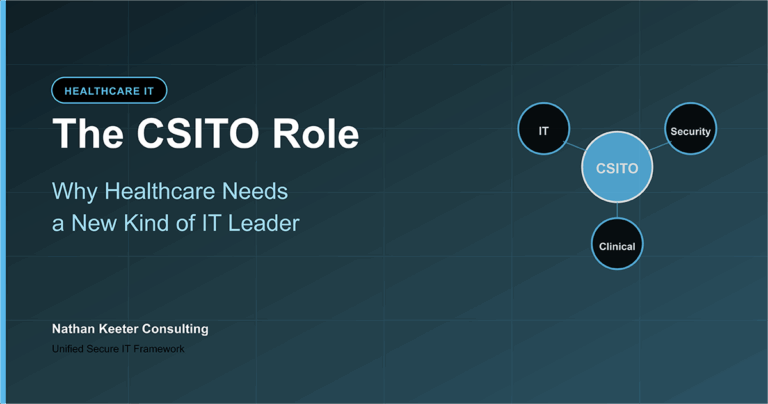
The Unified Secure IT (USIT) Framework addresses this structural problem directly by consolidating IT, security, and clinical technology under a single Chief Secure Information Technology Officer (CSITO).
Here’s how a unified structure would have changed Inotiv’s attack timeline:
Single point of visibility: One leader sees the entire attack surface—traditional IT, security operations, and clinical systems. No blind spots at organizational boundaries.
Unified authority: When suspicious activity is detected, there’s no committee needed to authorize investigation or response. The CSITO has both the visibility to understand the threat and the authority to act immediately.
Coordinated defense: Network monitoring, security alerts, and data governance operate as one system rather than three parallel tracks. A 176 GB data exfiltration gets detected and stopped because someone is watching the whole picture.
Clear accountability: The board knows exactly who is responsible for the organization’s security posture. No finger-pointing between IT and security when something goes wrong.
This isn’t about adding headcount or buying more tools. It’s about restructuring existing resources to eliminate the organizational vulnerabilities that attackers exploit.
The Data Theft Reality: Backups Won’t Save You
Here’s the uncomfortable truth that the Inotiv case makes explicit: your disaster recovery plan is no longer your security plan.
You can restore every system from backup. You can be back online in hours. But if 176 GB of sensitive data is already in criminal hands, you haven’t stopped the attack—you’ve just cleaned up the mess they left behind after they took what they wanted.
Traditional backup-and-restore strategies were designed for different threats: hardware failures, natural disasters, accidental deletions. They’re still necessary, but they’re no longer sufficient.
Modern security requires prevention and early detection, not just recovery. This demands organizational structures that can identify and stop data exfiltration while it’s happening—before the data leaves your network.
Three Questions for Your Board’s Next Meeting
If you’re a healthcare executive reading about Inotiv and wondering about your own organization’s readiness, here are the questions that matter:
1. Can anyone in your organization see our complete attack surface right now? If IT monitors the infrastructure, security monitors the logs, and clinical technology operates independently, the answer is no—and attackers know it.
2. If 176 GB of data started leaving our network today, how long would it take us to detect it? Be honest about the answer. Then ask: how long would it take to stop it once detected? If multiple teams need to coordinate, add days or weeks to your timeline.
3. Who is personally accountable to our board for preventing data theft? If the answer involves multiple titles or “it’s a shared responsibility,” you have a structural vulnerability that no amount of security tooling will fix.
Moving Forward: Structure Determines Outcomes
The Inotiv breach isn’t unique. It’s representative of a threat model that has become standard operating procedure for ransomware groups. Data theft first, system disruption second—or sometimes not at all, because once they have your data, they don’t need to encrypt anything to maintain leverage.
Healthcare organizations must adapt their structures to match this reality. The siloed model—IT over here, security over there, clinical technology somewhere else—was barely adequate when attacks were simple. Against modern threats that specifically target organizational seams and exploit coordination delays, it’s dangerously inadequate.
The USIT Framework offers an alternative: unified leadership that can see the complete picture, make decisive calls, and coordinate defense across all technology domains. It’s not the only possible solution, but it directly addresses the structural vulnerabilities that cases like Inotiv expose.
Your organization will likely never know whether you prevented an attack like this. But after reading about Inotiv’s 176 GB loss, you should be able to answer honestly: if attackers gained access to our network tomorrow and started mapping our most sensitive data, would our current organizational structure give us any real chance of stopping them in time?
If the answer is no, the question isn’t whether to restructure. It’s whether to restructure now, or wait until you’re writing your own disclosure letter.